Why Is There a Bird Wearing a Snail on Its Head?
I genuinely don't know.
Which, obviously, means we're going down the rabbit hole.
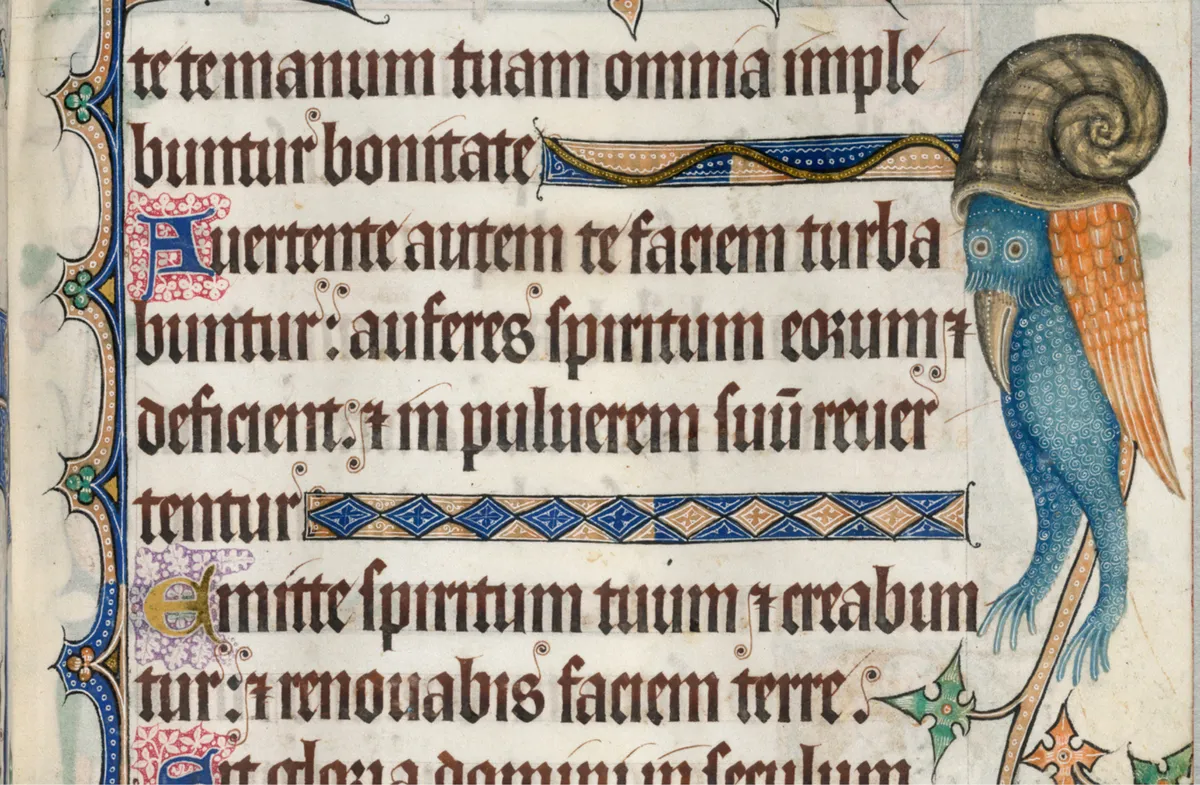
This wonderfully bizarre creature appears in the margins of the Luttrell Psalter, a manuscript made in England around 1325–1340 for Sir Geoffrey Luttrell.
And I have questions.
First of all: is that even a bird wearing a snail?
That's what it looks like to me. A bird-like creature, with what appears to be a snail shell sitting on its head or back.
But medieval manuscript artists weren't exactly constrained by our modern ideas about what constitutes a sensible animal.
The Luttrell Psalter is packed with strange creatures like this. Alongside its religious text and scenes of everyday life, its margins contain hybrids, monsters, animals behaving like people and all sorts of creatures that seem to exist for no immediately obvious reason.
So perhaps there's an explanation for this one.
Does it mean something?
Medieval marginal imagery has been interpreted in all sorts of ways.
Some strange creatures seem to have religious or moral associations. Others appear to be jokes, visual play or deliberate reversals of the natural order. Some may relate to the text on the page, while others seem to have little obvious connection to it at all.
And that's where things get tricky.
We can find theories about medieval grotesques and hybrids in general.
We can find plenty of discussion about snails in medieval art.
We can find interpretations of particular creatures elsewhere in the Luttrell Psalter.
But that doesn't mean we can take one of those explanations and simply stick it onto this creature.
We don't actually know what this particular artist intended it to mean.
And I rather like that.
Because it's very tempting, when looking at medieval manuscripts, to assume that every strange little creature must have some deep symbolic meaning.
Sometimes it probably did.
Sometimes it may have been a joke.
Sometimes it may have been connected to something that made perfect sense to the person looking at it in the fourteenth century.
And sometimes…
we just don't know.
So what the hell is it?
A bird?
A snail?
A bird wearing a snail?
Something else entirely?
I genuinely don't know.
But perhaps you've got a theory.
What do you think the artist was drawing — and why?
Sources: Courtesy British Library, Luttrell Psalter, Add MS 42130, f.185, England (East Anglia), c.1325–1335.