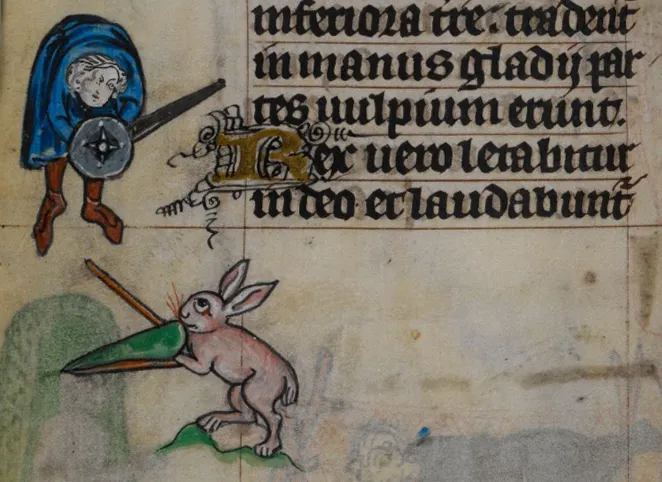
Detail from the Maastricht Book of Hours, BL Stowe MS 17, f.169v, c.1300–1325. British Library. Public domain.
WTAF????
I look at the records that documented life in the Middle Ages — from illuminated manuscripts and Psalters to court rolls and other surviving records — and fall down rabbit holes exploring them.
Discover the curious realities of medieval England through the things people left behind: the pictures they looked at, the things they wrote down, the lives they lived and the things that make us ask what on earth were they doing?
Come and explore the wonderfully messy Middle Ages.
Latest Article
-
Why Is There a Bird Wearing a Snail on Its Head?
I genuinely don't know.
Which, obviously, means we're going down the rabbit hole.
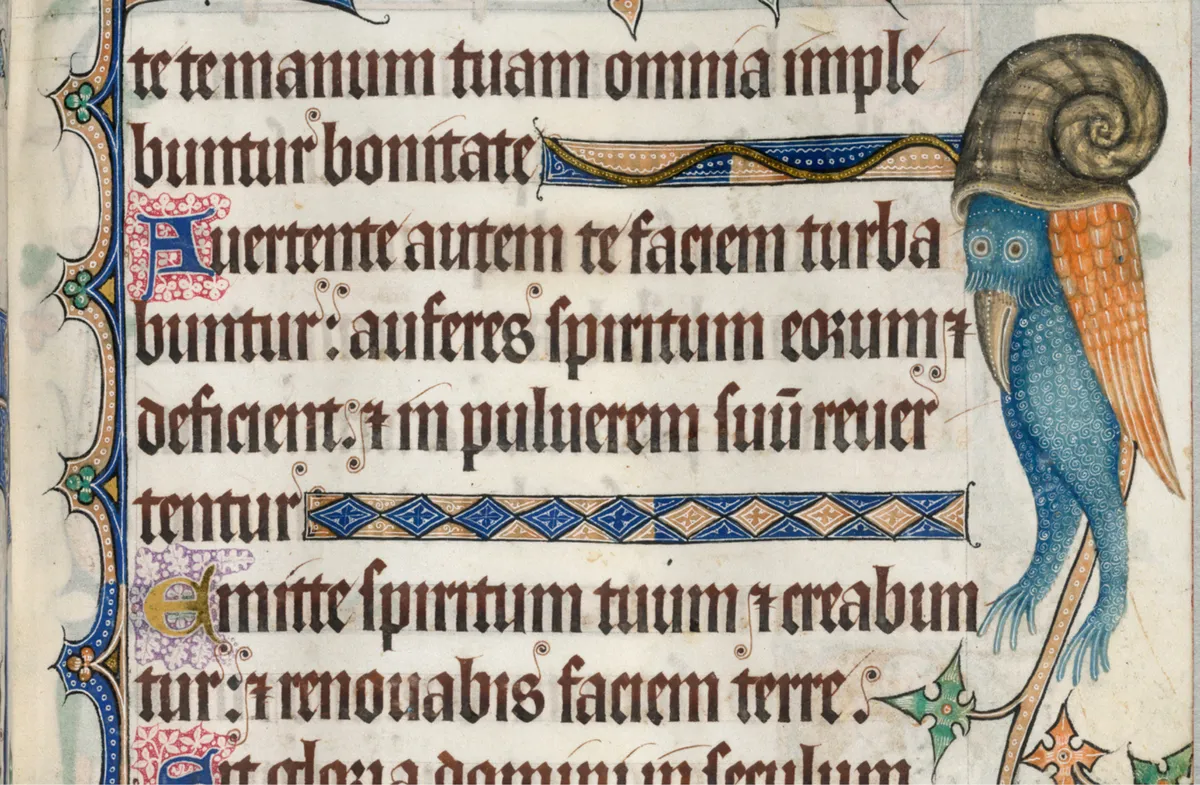
A wonderfully bizarre hybrid creature in the Luttrell Psalter, England, c.1325–1335. This wonderfully bizarre creature appears in the margins of the Luttrell Psalter, a manuscript made in England around 1325–1340 for Sir Geoffrey Luttrell.
And I have questions.
First of all: is that even a bird wearing a snail?
That's what it looks like to me. A bird-like creature, with what appears to be a snail shell sitting on its head or back.
But medieval manuscript artists weren't exactly constrained by our modern ideas about what constitutes a sensible animal.
The Luttrell Psalter is packed with strange creatures like this. Alongside its religious text and scenes of everyday life, its margins contain hybrids, monsters, animals behaving like people and all sorts of creatures that seem to exist for no immediately obvious reason.
So perhaps there's an explanation for this one.
Does it mean something?
Medieval marginal imagery has been interpreted in all sorts of ways.
Some strange creatures seem to have religious or moral associations. Others appear to be jokes, visual play or deliberate reversals of the natural order. Some may relate to the text on the page, while others seem to have little obvious connection to it at all.
And that's where things get tricky.
We can find theories about medieval grotesques and hybrids in general.
We can find plenty of discussion about snails in medieval art.
We can find interpretations of particular creatures elsewhere in the Luttrell Psalter.
But that doesn't mean we can take one of those explanations and simply stick it onto this creature.
We don't actually know what this particular artist intended it to mean.
And I rather like that.
Because it's very tempting, when looking at medieval manuscripts, to assume that every strange little creature must have some deep symbolic meaning.
Sometimes it probably did.
Sometimes it may have been a joke.
Sometimes it may have been connected to something that made perfect sense to the person looking at it in the fourteenth century.
And sometimes…
we just don't know.
So what the hell is it?
A bird?
A snail?
A bird wearing a snail?
Something else entirely?
I genuinely don't know.
But perhaps you've got a theory.
What do you think the artist was drawing — and why?
Sources: Courtesy British Library, Luttrell Psalter, Add MS 42130, f.185, England (East Anglia), c.1325–1335.
Explore More Medieval Life
-
Why Is There a Bird Wearing a Snail on Its Head?
I genuinely don't know.
Which, obviously, means we're going down the rabbit hole.
A wonderfully bizarre hybrid creature in the Luttrell Psalter, England, c.1325–1335. This wonderfully bizarre creature appears in the margins of the Luttrell Psalter, a manuscript made in England around 1325–1340 for Sir Geoffrey Luttrell.
And I have questions.
First of all: is that even a bird wearing a snail?
That's what it looks like to me. A bird-like creature, with what appears to be a snail shell sitting on its head or back.
But medieval manuscript artists weren't exactly constrained by our modern ideas about what constitutes a sensible animal.
The Luttrell Psalter is packed with strange creatures like this. Alongside its religious text and scenes of everyday life, its margins contain hybrids, monsters, animals behaving like people and all sorts of creatures that seem to exist for no immediately obvious reason.
So perhaps there's an explanation for this one.
Does it mean something?
Medieval marginal imagery has been interpreted in all sorts of ways.
Some strange creatures seem to have religious or moral associations. Others appear to be jokes, visual play or deliberate reversals of the natural order. Some may relate to the text on the page, while others seem to have little obvious connection to it at all.
And that's where things get tricky.
We can find theories about medieval grotesques and hybrids in general.
We can find plenty of discussion about snails in medieval art.
We can find interpretations of particular creatures elsewhere in the Luttrell Psalter.
But that doesn't mean we can take one of those explanations and simply stick it onto this creature.
We don't actually know what this particular artist intended it to mean.
And I rather like that.
Because it's very tempting, when looking at medieval manuscripts, to assume that every strange little creature must have some deep symbolic meaning.
Sometimes it probably did.
Sometimes it may have been a joke.
Sometimes it may have been connected to something that made perfect sense to the person looking at it in the fourteenth century.
And sometimes…
we just don't know.
So what the hell is it?
A bird?
A snail?
A bird wearing a snail?
Something else entirely?
I genuinely don't know.
But perhaps you've got a theory.
What do you think the artist was drawing — and why?
Sources: Courtesy British Library, Luttrell Psalter, Add MS 42130, f.185, England (East Anglia), c.1325–1335.
-
Monkeys Dancing?
Look what I found. What on earth?
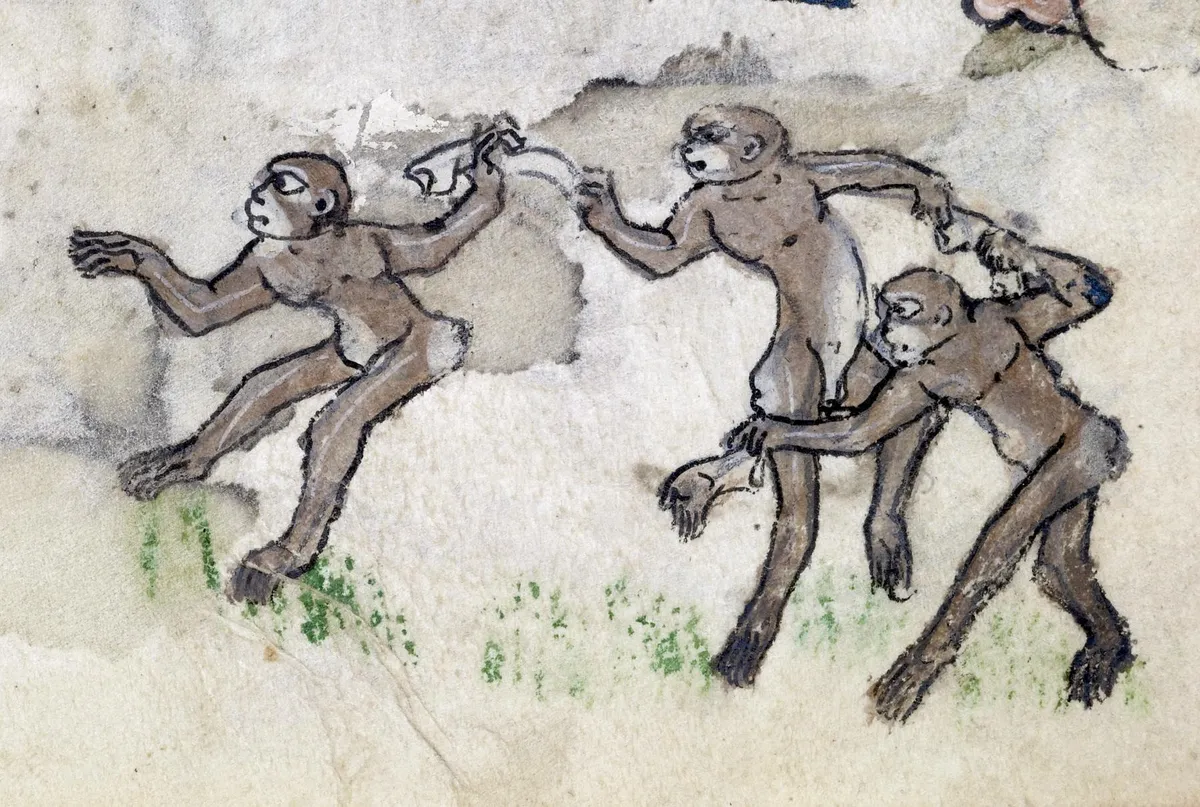
Detail from a Flemish Psalter-Hours, Ghent, c. 1315–1325. Walters Art Museum, W.82.193R. Public Domain. So what are we looking at?
This is a detail from a Flemish Psalter-Hours made in Ghent around 1315–1325. The Walters Art Museum identifies the figures as apes or monkeys dancing in a circle and gives the image the rather extraordinary title “Apes Dancing to Ring-around-a-Rosy.”
But here's where I got stuck.
How do we know they're dancing to Ring-a-Ring o' Roses?
The obvious problem is the date. This manuscript was made around 1315–1325 — before the Black Death reached Europe in the late 1340s. And the familiar plague interpretation of Ring-a-Ring o' Roses isn't supported by the historical evidence for the rhyme. The Library of Congress notes that the plague explanation emerged much later and has not been accepted by folklorists.
So the question isn't really “Were medieval people dancing Ring-a-Ring o' Roses?”
They obviously weren't dancing to the nursery rhyme as we know it.
The question is:
Why has the Walters identified this particular medieval ring dance with that particular modern nursery rhyme?
We don't know why the image was originally made.
We don't know whether the artist intended a particular dance.
We don't know whether it represents a specific medieval game or performance.
And we don't know the basis for the Walters' Ring-around-a-Rosy identification.
And that last one is the question I've asked them.
So I've asked them.
If I hear back, I'll update this post and let you know what they say.
Because now I really want to know. 😂
Until then, I'll leave you with the question: what on earth are these apes doing?
-
Were medieval women always waiting in towers to be rescued?
Were medieval women always waiting in towers to be rescued?
Not quite.
Sometimes they're the ones defending the castle.Look closely at this medieval manuscript image.
A man is climbing a ladder towards a castle wall.
And waiting for him at the top is a woman.
With a sword.
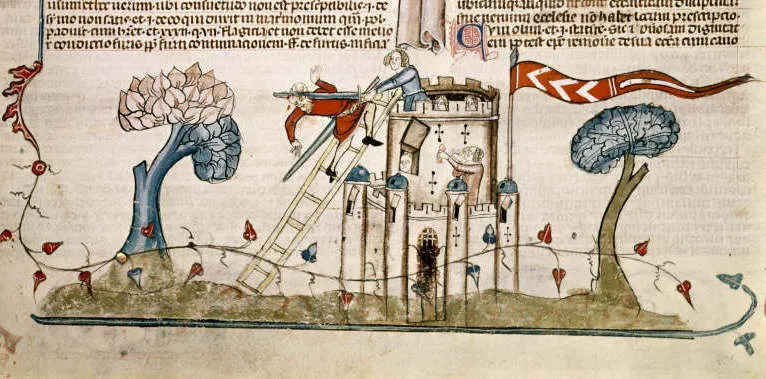
A woman strikes an attacker climbing a ladder as he attempts to storm a castle. Detail from the Smithfield Decretals, England (London?), c.1340. British Library, Royal MS 10 E IV. This is from the Smithfield Decretals, a fourteenth-century English manuscript, made around 1340.
We don't know who she is.
We don't know if the artist had a real woman in mind, or a story, or just liked the idea of it.
But it wasn't as far-fetched as it sounds.
When a husband was away, imprisoned, or dead, responsibility for a castle could fall to his wife — including its defence.
Nicola de la Haye, for example, played a major role in the defence of Lincoln Castle during the First Barons' War.
So maybe this is her.
Maybe it's no one in particular.
Either way, somewhere around 1340, someone decided a woman with a sword on a castle wall was a perfectly reasonable thing to draw.
And I rather like that.
Source
British Library, Smithfield Decretals, Royal MS 10 E IV, England (London?), c.1340.
-
The Story of Life in the Middle Ages
I'm delighted to be joining Robert Birming's AuguStory challenge, where bloggers are sharing the stories behind their blogs, how they got started, and where blogging has taken them.
And the funny thing is, Life in the Middle Ages wasn't really the blog I set out to create.
I'm just very good at falling down rabbit holes.
It Usually Starts With a Picture
I've always loved history, particularly the bits that make you stop and think, wait... they actually did that?
I love visiting castles — the more ruined, the better. Standing among broken walls, I find myself wondering who lived there, what they did all day, what they ate, what they argued about, and what the place looked like when it was full of people rather than tourists.
But it wasn't really castles that started Life in the Middle Ages.
It was pictures.
I started spending ridiculous amounts of time looking through medieval manuscripts. Not just the famous paintings of kings and saints, but the little scenes tucked into the margins and pages.
A man having a tooth pulled.
A baker at work.
Someone being chased through the streets.
A woman defending a castle with a sword.
A swarm of ants marching towards a field.
And suddenly there's a story.
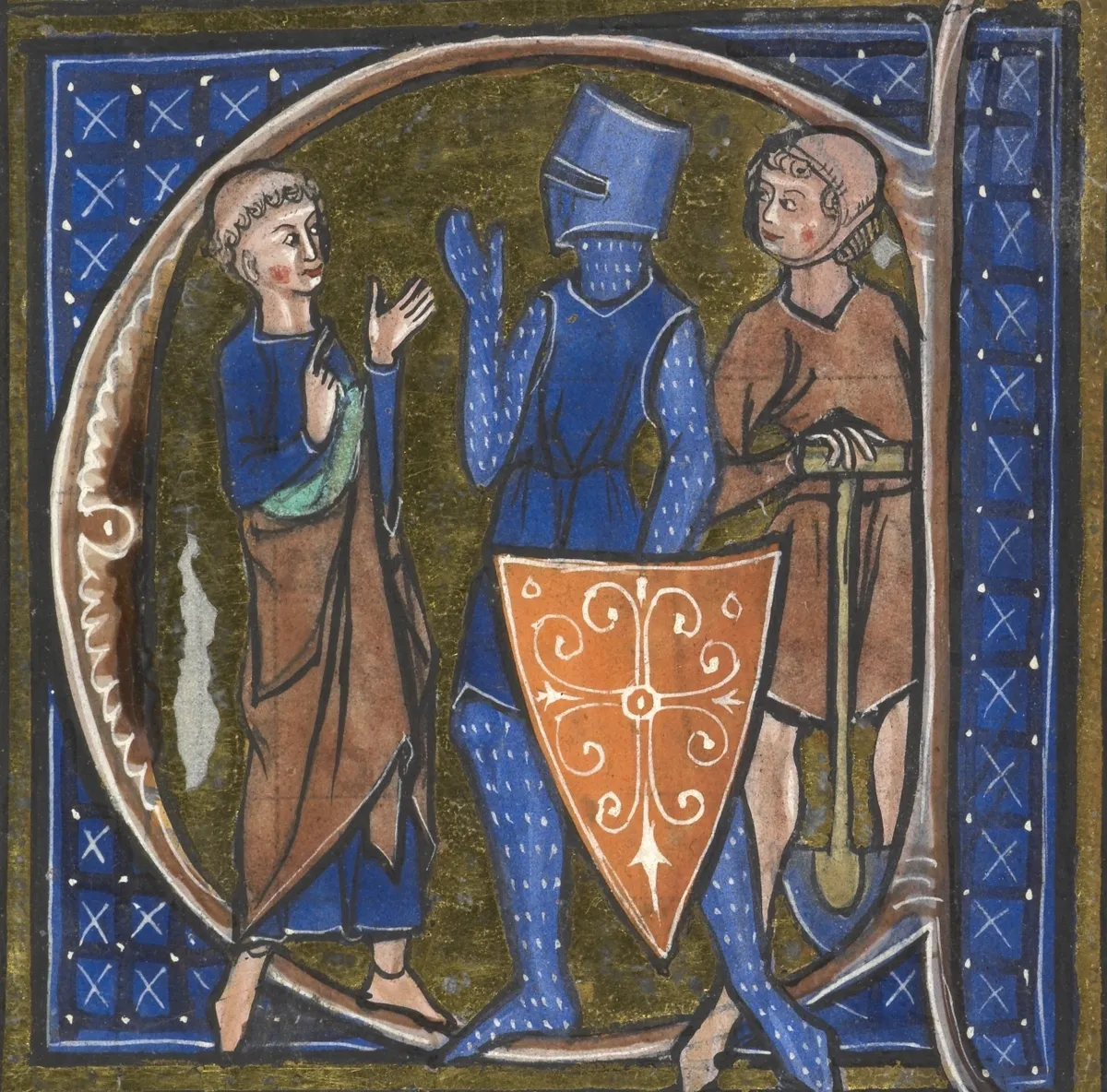
Cleric, knight and workman representing the three classes, from Li Livres dou Santé, late 13th century, MS Sloane 2435, f. 85. British Library. That's what I find myself doing now: looking at something that was painted or written hundreds of years ago and asking, what's the story here?
Sometimes the answer is ordinary. Sometimes it's surprisingly funny. And sometimes it's so strange that you have to check the source three times because surely nobody actually did that.
They usually did.
Finding the People Behind the History
The more I looked, the less interested I became in kings and battles.
I wanted to know about everyone else.
The farmers. The bakers. The villagers. The women running households. The people appearing in the margins of manuscripts without anyone ever bothering to tell us their names.
More recently, I've fallen down another particularly dangerous rabbit hole: medieval manor court rolls.
I can now happily spend an evening reading seven-hundred-year-old records about wandering pigs, blocked ditches and neighbours arguing over fences.
And somehow, those tiny disputes feel incredibly alive.
Someone owned that field.
Someone else's cow got into it.
Someone was furious.
Someone went to court.
Seven hundred years later, we're still reading about it.
That's the part of medieval history I love most.
Not the grand story. The little one.
And Then There Was Middle Woe
Eventually I started wondering what would happen if I stopped simply writing about medieval people and invented some of my own.
That became Middle Woe — a fictional medieval village inspired by the real world I've been disappearing into.
There are parish notices. Court disputes. Village gossip. Bureaucracy. And, inevitably, people taking completely ordinary problems far too seriously.
It's fictional, but almost everything in it has roots in something I've found in the historical record.
Finding My Place to Write It
I've blogged on just about every platform imaginable over the years — WordPress, Blogger, Medium, Tumblr, Substack and probably several others I've forgotten.
I've bought domain names that seemed like excellent ideas at the time and abandoned projects when my attention wandered somewhere else.
Then I found Bear Blog.
And something clicked.
It's simple. I can write. I can play with the HTML and CSS. I can change things when I have an idea rather than spending half my life trying to make a theme behave.
More importantly, it feels like my little corner of the internet.
So What's Next?
I don't really know.
And, for once, I'm quite happy about that.
Because I don't have a carefully planned five-year content strategy.
I have a folder full of manuscript images, a growing collection of medieval court cases, far too many open browser tabs and a long list of things that have made me say, surely that's not true?
And that's probably enough.
Because there's always another picture.
Another strange little record.
Another forgotten person.
Another story waiting somewhere in the margins.
All I have to do is find it.
-
Meet the Citole: The Medieval Instrument That Almost Disappeared
This musician appears in a 700-year-old medieval manuscript.
What exactly are they playing?
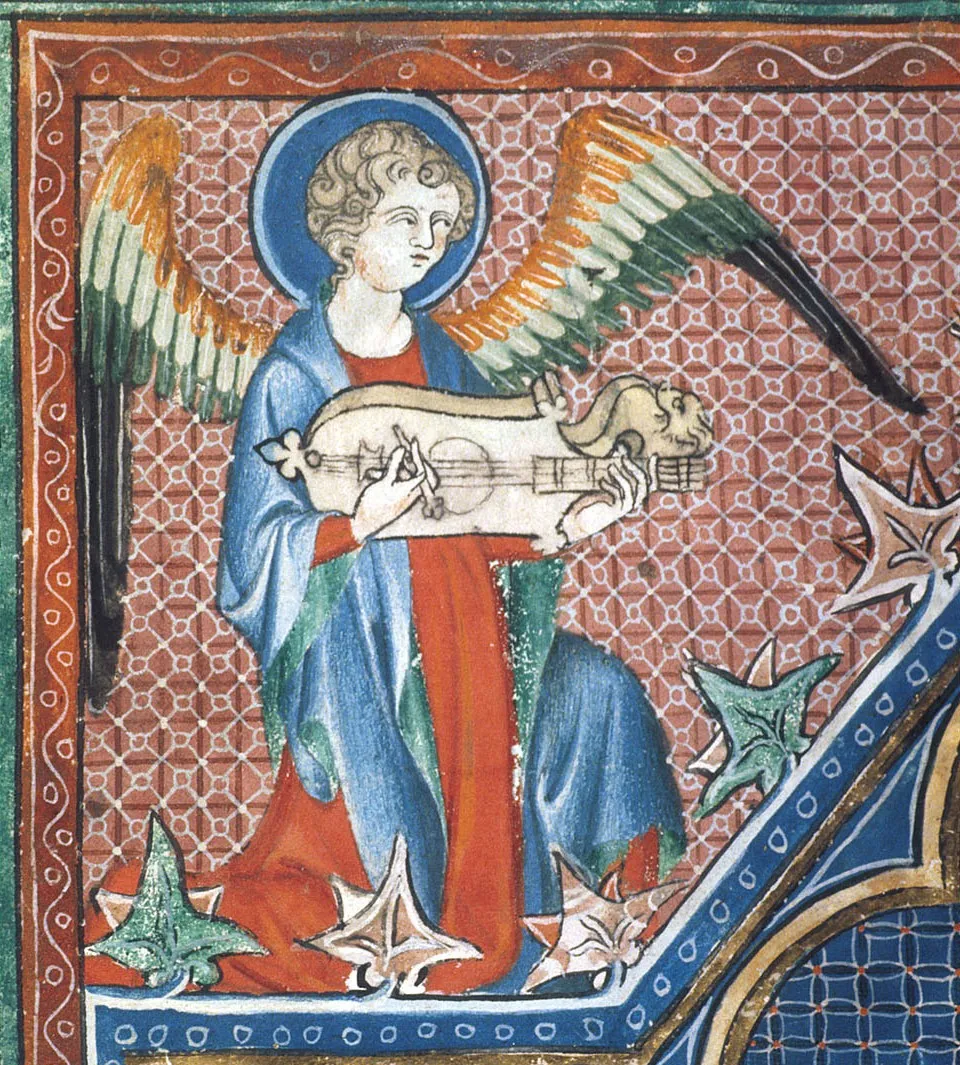
An angel playing a citole from the De Lisle Psalter, England, c.1310 (British Library, Arundel MS 83, f.134v). Public Domain. The manuscript above captures more than a medieval musician. It preserves evidence of an instrument that has almost disappeared, yet whose descendants are still being played today.
At first glance, the instrument looks unfamiliar. It has a rounded body, a short neck and is being played with a plectrum. It isn't a guitar, although it may remind you of one.
It's called a citole, one of the most distinctive stringed instruments of the Middle Ages.
What Was a Citole?
The citole was a plucked string instrument that became popular across Europe during the thirteenth and fourteenth centuries. It was played by professional musicians, travelling entertainers and court performers, accompanying songs, dances and storytelling.
Unlike the modern guitar, the citole usually had four strings and a characteristically shaped body with curved or waisted sides. It was played using a plectrum rather than the fingers.
What Did It Sound Like?
No medieval recordings survive, of course, but modern reconstructions suggest the citole produced a bright, clear sound that carried well indoors. It was well suited to accompanying singers and adding rhythm to dances.
Today, musicians who specialise in medieval music have recreated citoles using surviving examples and contemporary illustrations, allowing us to hear something remarkably close to the sounds medieval audiences would have recognised.
Is It Related to the Guitar?
Not directly, but it belongs to the same broad family of plucked string instruments. Over the centuries, instruments such as the citole gradually evolved into later forms including the cittern and, eventually, instruments that influenced the modern guitar.
Although separated by hundreds of years, they share the same basic idea: stretched strings, a wooden body and music created by plucking them.
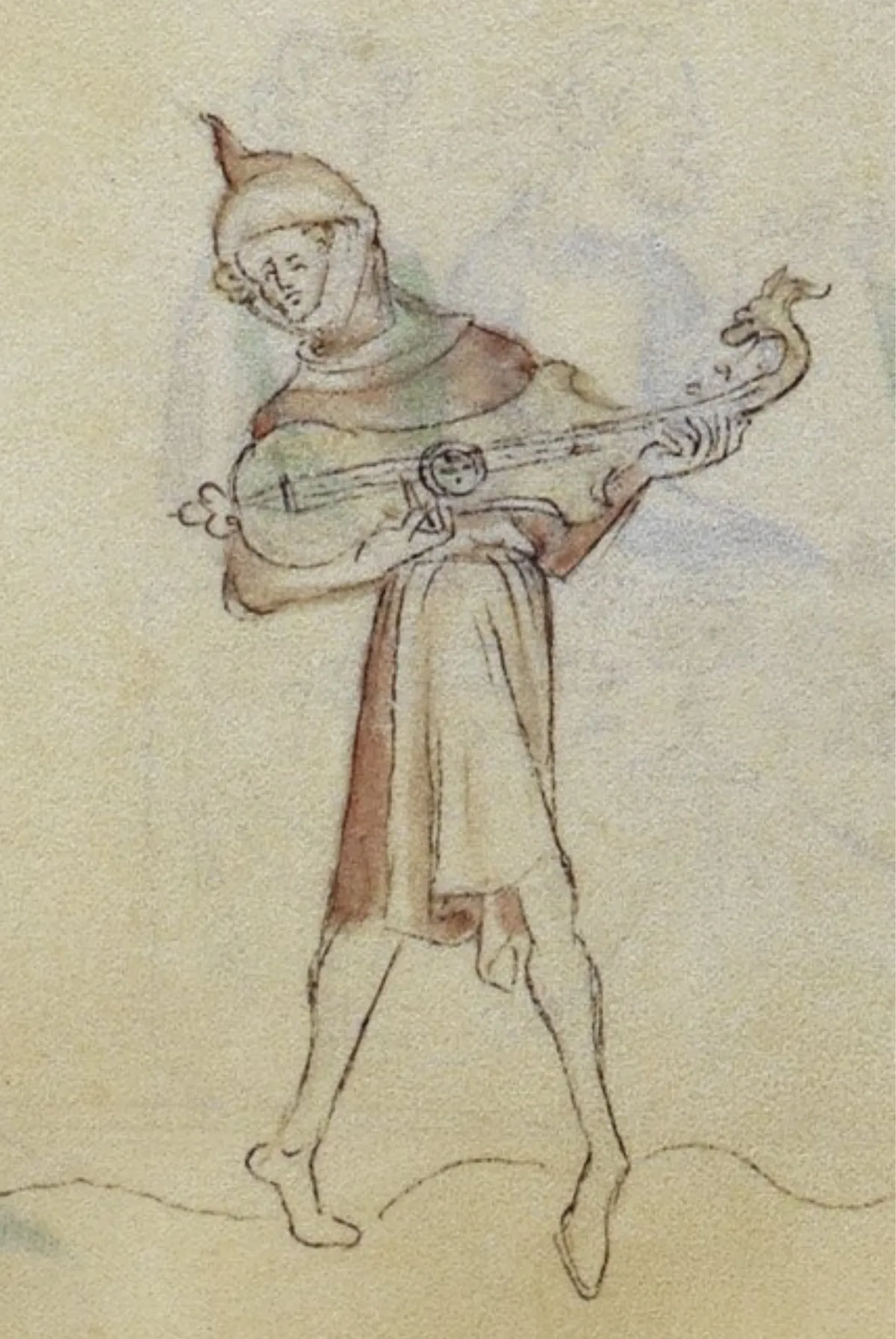
A musician playing a citole from the Queen Mary Psalter, England, c.1310–1320. British Library. Public Domain. The next time you hear someone strumming a guitar, remember that its musical family stretches back much further than you might think.
Sources & Image
Images:
- Angel playing a citole, De Lisle Psalter, England, c.1310. British Library, Arundel MS 83, f.134v. Public Domain.
- Musician playing a citole, Queen Mary Psalter, England, c.1310–1320. British Library, Royal MS 2 B VII. Public Domain.
Further Reading:
- British Library Digitised Manuscripts.
- Wikimedia Commons (image access and licensing).
- Christopher Page, The Owl and the Nightingale: Musical Life and Ideas in France 1100–1300.
-
Medieval Tooth Extractions
Someone Is Having Their Tooth Pulled. What on Earth?
Look what I found in a medieval manuscript.
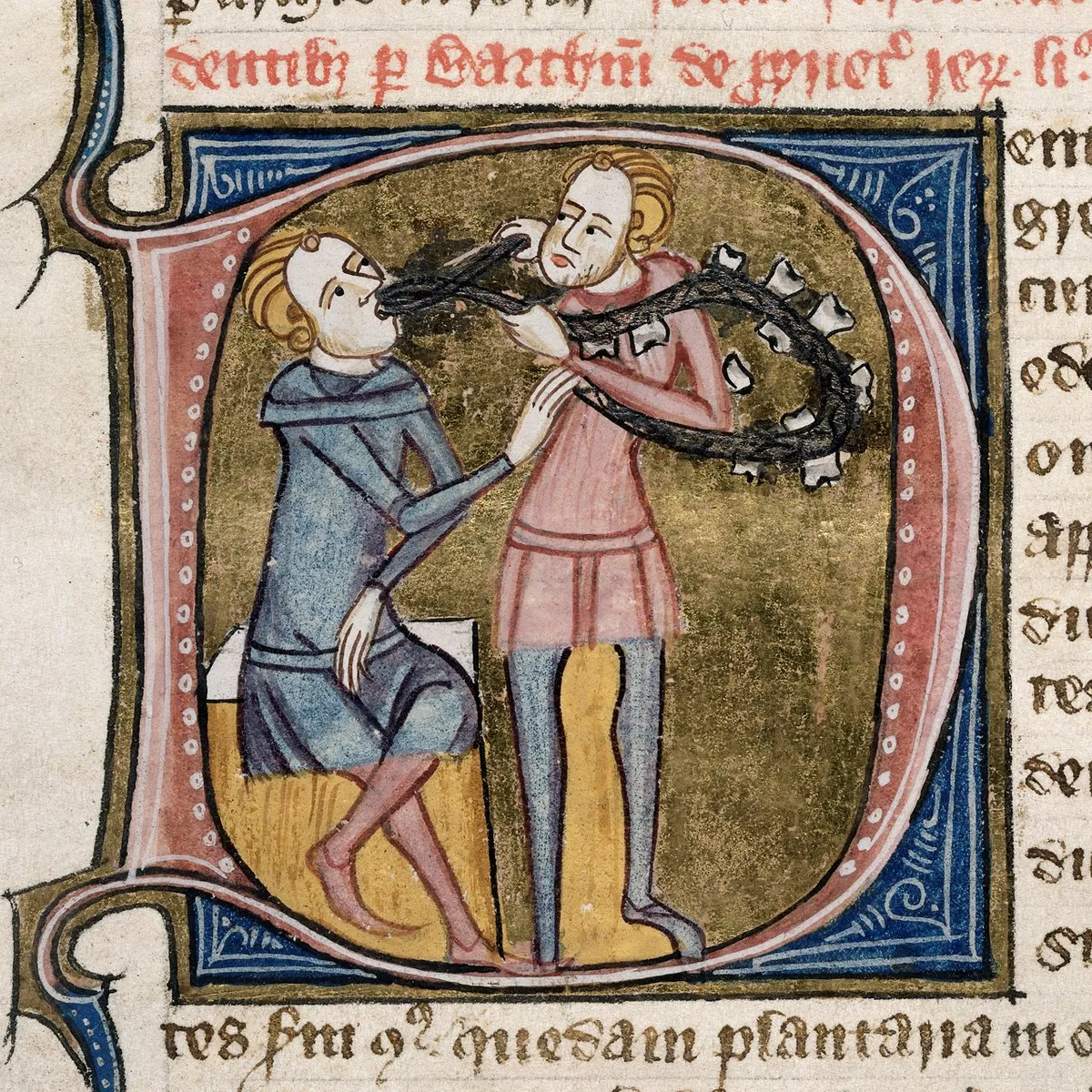
A medieval dentist extracting a tooth, from Omne Bonum, c.1360–1375. Wait. WHAT?
There it is, tucked into a medieval manuscript: a person having a tooth pulled while someone else appears to be doing the pulling.
It's a tiny picture, but it immediately raises a rather obvious question.
What was actually going on when your tooth hurt in the Middle Ages?
So what are we looking at?
This is a historiated initial ‘D’ for dentes (teeth) in the Omne Bonum, a huge encyclopaedic work compiled by James le Palmer in London around 1360–1375.
The image shows a dentist extracting a patient's tooth.
And suddenly this isn't just a strange little medieval picture.
It's a piece of evidence.
Because medieval people had toothache too.
They had teeth that hurt, teeth that broke, teeth that became infected and teeth that eventually had to come out.
They also had some rather interesting ideas about why teeth hurt.
The tooth worm
One long-standing explanation for toothache was the tooth worm — a tiny creature believed to burrow into the tooth and cause pain.
And if you believed a worm was causing your toothache, you needed a way to get rid of it.
Some remedies involved herbs, oils, poultices, prayers and charms. One particularly memorable treatment involved burning henbane seeds beneath the patient's mouth. The smoke produced tiny worm-shaped strands of ash, which could be interpreted as the worms leaving the tooth.
Whether that actually removed anything is another matter.
But the idea makes a little more sense when you remember that medieval medicine was working with a very different understanding of how the body worked.
And when the tooth wouldn't stop hurting?
Sometimes the answer was simply:
Take it out.
The image above gives us a glimpse of that process.
There was no modern dental surgery. There was no anaesthetic as we know it today. The tools and techniques were very different.
And yet the basic problem is instantly recognisable.
That tooth hurts. Get the bloody thing out.
And this is the bit I love.
We don't have to imagine what medieval dentistry looked like.
Someone actually drew it.
More than six hundred years later, we can still look at this tiny image and see a medieval dental procedure taking place.
We don't know everything about the person in the picture. We don't know who they were, what had happened to their tooth, or exactly how the procedure felt.
But we do have this.
A little piece of evidence, sitting inside a manuscript that has survived for centuries.
So the next time your dentist asks if you've been flossing, spare a thought for whoever was sitting in that medieval chair.
Because it could be worse.
They could be reaching for the forceps.
Image Source
Image: A dentist extracting a tooth, historiated initial ‘D’ for dentes (teeth), from the Omne Bonum, compiled by James le Palmer, London, c.1360–1375. Royal MS 6 E VI, f.503v. British Library. Public Domain, via Wikimedia Commons.
-
How Do We Know What Medieval Life Really Looked Like?
<>What do a medical handbook, two prayer books and a book of Church law have in common? Surprisingly, they are some of the greatest windows into everyday life in the Middle Ages.
When people imagine medieval manuscripts, they often picture pages filled with Latin writing, saints and gold leaf. While those things certainly exist, many manuscripts contain something far more unexpected: ordinary people going about their daily lives.
Farmers harvesting crops. Shepherds tending sheep. Women spinning wool. Bakers making bread. Kings fighting battles. These scenes were never intended to be historical records, yet today they provide some of the richest visual evidence we have for understanding life in medieval Europe.
Four remarkable manuscripts in particular have become invaluable to historians. Although each was created for a different purpose, together they preserve an extraordinary glimpse into the lives of ordinary medieval people.
Tacuinum Sanitatis
The Tacuinum Sanitatis began life as a medical handbook written in eleventh-century Baghdad by the physician Ibn Butlan. It explained how food, exercise, sleep and the changing seasons affected health. During the late fourteenth century, wealthy patrons in northern Italy commissioned lavishly illustrated copies, transforming a practical guide into one of the finest visual records of medieval daily life.
Its pages show gardeners, farmers, cooks, merchants and labourers alongside the fruits, vegetables and animals that shaped medieval diets.

Cabbages being harvested, illustrated in the 14th-century Tacuinum Sanitatis . Luttrell Psalter
Created in England between about 1325 and 1340 for Sir Geoffrey Luttrell, the Luttrell Psalter is a beautifully illuminated book of Psalms. While intended for private devotion, its illustrations provide an extraordinary glimpse into medieval English rural life.
Ploughmen work the fields, shepherds tend their flocks, labourers harvest crops and villagers go about their daily lives. Few surviving manuscripts capture the rhythms of medieval England with such warmth and detail.
.png)
Sheep gathered in a medieval sheep pen, illustrated in the Luttrell Psalter . Queen Mary Psalter
Produced in England around 1310–1320, the Queen Mary Psalter is one of the greatest illuminated manuscripts of the Middle Ages. Alongside biblical stories are hundreds of illustrations depicting hunting, animals, historical events and scenes from everyday life.
One striking image shows King Oswald of Northumbria fighting King Penda of Mercia at the Battle of Maserfield in AD 642, demonstrating how medieval artists also recorded important moments from England's past.

Oswald of Northumbria fighting Penda of Mercia at the Battle of Maserfield, illustrated in the Queen Mary Psalter . Smithfield Decretals
The Smithfield Decretals are perhaps the most unexpected of all. Although the text itself is a collection of medieval Church law, the margins are filled with lively and often humorous illustrations that reveal the personalities and everyday experiences of medieval people.
Among its many delightful scenes is an affectionate encounter between a man and a woman at her spinning wheel, reminding us that medieval manuscripts could capture moments of humour, affection and ordinary human life alongside their more serious purpose.
_(c.1340),_f.139_-_BL_Royal_MS_10_E_IV.jpg)
An amorous encounter, illustrated in the Smithfield Decretals (c. 1340). Why These Manuscripts Matter
None of these manuscripts were created to document everyday life. Yet together they preserve an extraordinary record of farming, food, clothing, work, relationships and even historical events. They allow us to glimpse the lives of people whose stories are rarely recorded in written documents.
For historians, these manuscripts are far more than beautiful works of art. They are windows into a world that disappeared centuries ago, helping us understand not only medieval kings and nobles, but also the farmers, shepherds, craftsmen, women and families who shaped life in the Middle Ages.
Image Credits
- Tacuinum Sanitatis. Österreichische Nationalbibliothek, Cod. Vind. Ser. n. 2644. Public domain.
- Luttrell Psalter. British Library, Add MS 42130, f.163v. Public domain.
- Queen Mary Psalter. British Library, Royal MS 2 B VII. Public domain.
- Smithfield Decretals. British Library, Royal MS 10 E IV, f.139. CC0 1.0 Universal Public Domain Dedication.
Sources & Further Reading
- British Library Digital Collections.
- Österreichische Nationalbibliothek Digital Collections.
- Wikimedia Commons (image access and licensing).
-
When Insects Were Taken To Court
A Swarm of Ants Is Marching Toward the Crops. Someone Is About to Take Them to Court.
Look at them. Dozens of ants, heading straight for the crops.
This is from an English bestiary, made around 1250–1260.
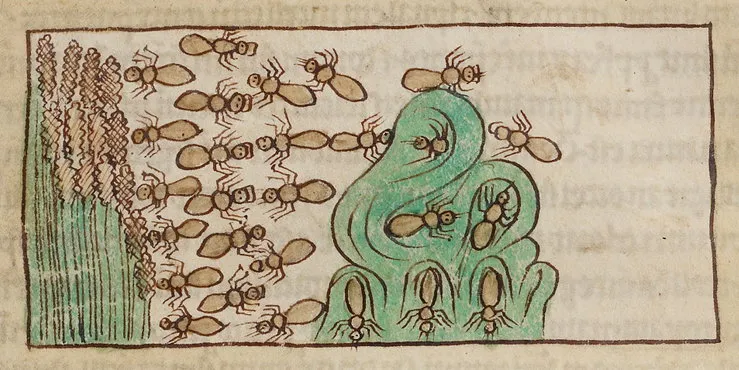
A swarm of ants approaching crops, illustrated in the Northumberland Bestiary, England, c.1250–1260. The J. Paul Getty Museum, Ms. 100, fol. 23r. And in parts of medieval Europe, this wasn't just something you watched happen.
It was something you could take to court.
From the thirteenth century onwards, church courts in parts of France, Switzerland and northern Italy occasionally summoned destructive swarms — locusts, beetles, caterpillars and other pests — to answer for the damage they had caused.
Not one insect.
The whole swarm.
Formally. Collectively.
And someone had to argue their side.
Records survive of advocates being appointed to defend the insects, arguing that they too were part of God's creation and had a right to exist.
If no agreement could be reached, the court could order the swarm to leave the affected land within a set number of days.
If they didn't? Excommunication.
By the Church. Officially.
Did the ants comply?
They did not.
The point wasn't really whether the insects understood the judgement. What mattered was that a court had convened, an argument had been heard, and the whole business had been done properly — while, somewhere in the margin, a scribe had already drawn exactly what everyone was so worried about.
Sources
- Northumberland Bestiary, Ms. 100, fol. 23r, England, c.1250–1260. The J. Paul Getty Museum. CC0.
-
A Woman Had a Cat That Sucked Milk From Her Neighbours' Cows. What on Earth?
A Woman Had a Cat That Sucked Milk From Her Neighbours' Cows. What on Earth?
Look what I found in a medieval visitation record.
A bishop was visiting the churches of medieval Herefordshire.
And among the things reported to his officials was an accusation of sorcery against a woman who allegedly kept an animal in the shape of a cat which sucked milk from her neighbours' cows.
Wait. WHAT?
So what are we actually looking at?
This comes from the surviving records of episcopal visitations in the Diocese of Hereford.
By the late thirteenth century, bishops were carrying out increasingly organised inspections of the churches and communities within their dioceses. Their officials collected information about the condition of churches, the behaviour of clergy and the conduct of local people.
And people complained.
Quite a lot.
What did they report?
The records contain accusations and observations concerning things such as:
- adultery and fornication
- violence and disorder
- usury
- clergy keeping concubines
- poorly maintained church buildings
- missing church lights
- defective baptisteries
- neglected rectories and chapels
And then there's the cat.
Or, more accurately, an accusation involving a woman and an animal described as being in the shape of a cat, which was said to suck milk from her neighbours' cows.
But here's where it gets interesting.
It's very tempting to read this and think:
“So medieval people genuinely believed a woman had a magical milk-stealing cat.”
But the record doesn't necessarily allow us to say that.
What we have is an accusation.
Someone reported something to the bishop's officials, and the allegation was written down as part of an official visitation.
That doesn't tell us whether the animal actually existed.
It doesn't tell us whether the woman admitted to anything.
It doesn't tell us whether the accusation was true.
And it doesn't even tell us exactly what was happening between the woman and her neighbours.
So why was the bishop asking?
Because these visitations weren't simply religious tours.
They were part of an increasingly organised system of inspecting churches and investigating the behaviour of clergy and communities.
Local people could present faults and complaints to the bishop's officials, who recorded them and could investigate further or order corrections.
In other words, someone had to actually tell the authorities about the milk-stealing cat.
And that is what makes these records so fascinating.
Medieval history can sometimes feel impossibly distant.
Kings. Bishops. Battles. Castles.
But then a document survives in which somebody has essentially said:
“There's a woman in our neighbourhood and her cat is drinking our cows' milk.”
And suddenly you're looking at something much more recognisable.
Neighbours complaining about neighbours.
Officials taking notes.
Rumours becoming allegations.
And a community deciding that something was serious enough to report.
Here's what we know.
The accusation was recorded during the medieval visitation process in the Diocese of Hereford.
The surviving records preserve a remarkable range of complaints and observations about local communities.
Here's what we don't know.
We don't know whether the woman actually kept such an animal.
We don't know what the animal really was.
We don't know whether the cows were actually losing milk.
And we don't know what happened to the woman afterwards.
But we do know one thing.
Someone thought it was worth telling the bishop.
And honestly, I have so many questions.
What did this “cat” actually look like?
Was someone stealing milk?
Was there a perfectly ordinary explanation?
Or was this simply a neighbourly dispute that somehow ended up in the bishop's paperwork?
We may never know.
Image Source

Robert Grosseteste, Bishop of Lincoln, from a 14th-century English manuscript, British Library, Harley MS 3860, f. 48. Source
Records of episcopal visitations in the Diocese of Hereford, including the visitation records of Richard Swinfield, Bishop of Hereford, in the late thirteenth century.
-
Why Did Medieval Villagers Hit Things With Sticks?
Every year, medieval villagers walked around the entire boundary of their parish.
They carried willow wands.
They hit boundary stones, trees, ditches and other important landmarks.
And, in some accounts, they also gave the children a memorable introduction to local geography by bumping or pressing them against the boundary markers.
Wait. WHAT?
So what were they doing?
This was Beating the Bounds, a tradition associated with Rogationtide — the three days before Ascension Day.
The procession brought together the rector, churchwardens, local officials, villagers and children, who walked the boundaries of their parish together.
And this wasn't simply a pleasant spring walk.
The boundary mattered.
In medieval England, parish boundaries determined much more than where one piece of countryside ended and another began.
They helped establish which parish you belonged to, where tithes were paid, which court had authority over you, and who held rights over land such as meadows, woodland and pasture.
There were few accurate maps available to ordinary people.
So if everyone forgot where the boundary was, things could get complicated.
So they walked it.
As the procession moved around the parish, important landmarks were identified and struck with willow wands.
Stones.
Trees.
Ditches.
Streams.
Ancient crosses.
The idea was to make sure that the community remembered exactly where the boundary lay.
And that gave us the rather wonderful name Beating the Bounds.
And then there were the children.
This is the bit that makes me stop.
Children were deliberately included in the procession because they were going to be the adults who needed to remember the boundary in the future.
At important points, some accounts describe children being bumped, bounced or pressed against the boundary marker itself.
The theory was simple:
If you gave a child a memorable experience at that particular stone, they might still remember where it was when they were grown.
Whether the children regarded this as an excellent educational opportunity is, unfortunately, not recorded.
But why do it during Rogationtide?
Rogationtide was already a time when communities processed through the countryside and prayed for God's blessing on the fields and the coming harvest.
So the boundary walk combined several things at once:
- religious procession
- communal memory
- local geography
- and the practical business of knowing where the parish ended.
The community walked the land together, prayed for the coming harvest and renewed its knowledge of the parish boundary.
Here's the bit I love.
Today, we look at a boundary on a map.
A line.
A name.
Perhaps a little black dot marking a boundary stone.
But for medieval villagers, the boundary wasn't necessarily something you could simply look up.
You knew it because you had walked it.
You knew the old tree.
You knew the ditch.
You knew the stone.
And, if you were particularly unlucky, you remembered exactly which one you'd been pushed against as a child.
And somehow, the tradition survived.
Beating the Bounds didn't disappear when better maps arrived.
In some places it became more ceremonial, while elsewhere it was revived as a way of preserving local history.
Some English parishes and Oxford colleges still carry out versions of the tradition today.
The medieval necessity may have disappeared.
But the idea of walking the boundary and remembering the landscape has survived.
So the next time you see a parish boundary on a map, remember:
For centuries, people didn't just draw the boundary.
They walked it.